McDangerous wrote
Good gracious, what is that monstrosity? It's HUGE! Love the colours and the design, but the 10 strings? Why?
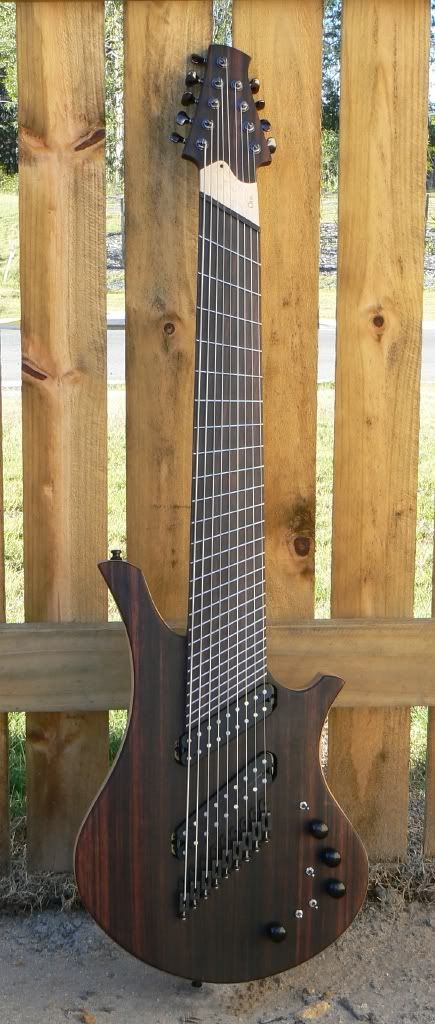
It's an Oni, I absolutely love them, majorly forward thinking in terms of extended scale guitars. It's a 9 string, as for the reasoning why not? I have big hands so to me playing 8 string feels pretty normal, I imagine with the ergonomics and fanned frets of an Oni that a 9 string wouldn't be too terrible a stretch. Guitarists seem very complacent with having a relatively small range, I'm personally of the mindset that if you can handle more strings then why not? I realise that it's not everyone's thing but playing 7s and then 8s got me realising that I personally no longer see a reason to want a 6 string and in honesty the two six strings I own I haven't touched in almost a year seeing as I can play anything I play on 6 on a 7, the 8 does feel very different but then again it's super comfy to me and I really enjoy having more range to experiment with. In my band my bassist plays a 6 string and I play a 7 and an 8 so it allows us to explore quite a bit in terms of orchestration.
As for Oni, one of the new things they're trying to perfect is what they refer to as an E (exponential) scale. It's a fanned fret system with a bigger curvature on the low strings. The reason for it as taken from Oni's blog:
"The whole compound scale thing has become a useful tool for extended range guitars and basses. The reason is simple and commonly understood now – lower pitch strings work better on longer scales, the tone is better and the longer length allows for a smaller diameter string at any given combination of pitch and tension. The higher pitch strings don’t react so well to increased scale length, either becoming too tight or requiring very delicate string gauges that break easily and are hard to get. Add to that some ergonomic benefits, particularly at the nut end of the neck, and it’s a nice design solution for particular types of instrument. The problem is that there are some ergonomic side effects with the usual compound layout. The big one for a lot of players is that the angle of the frets past the 12th – 15th fret area becomes uncomfortable.
The main idea behind e-scale and it’s curved frets is to put those upper frets at a more comfortable angle, while retaining the maximum comfortable total scale length difference from treble to bass strings."