Ok, so if you've bothered to read all that, then lets begin. I'm going to try to keep this generic and not get too tied to specific brands of Multi-Effects processors. I happen to own a Boss GT-8 though, and it is from that frame of reference that I make these posts. I haven't used any of the others available, and so any guru's who happen to know the Tonelabs, Digitech's etc etc, please feel free to add.
Firstly, lets look at getting it connected. If you want to connect it to a guitar amp, you want to use the 4 Cable Method, as this will give you the most flexibility.
Take a look at the diagram below:
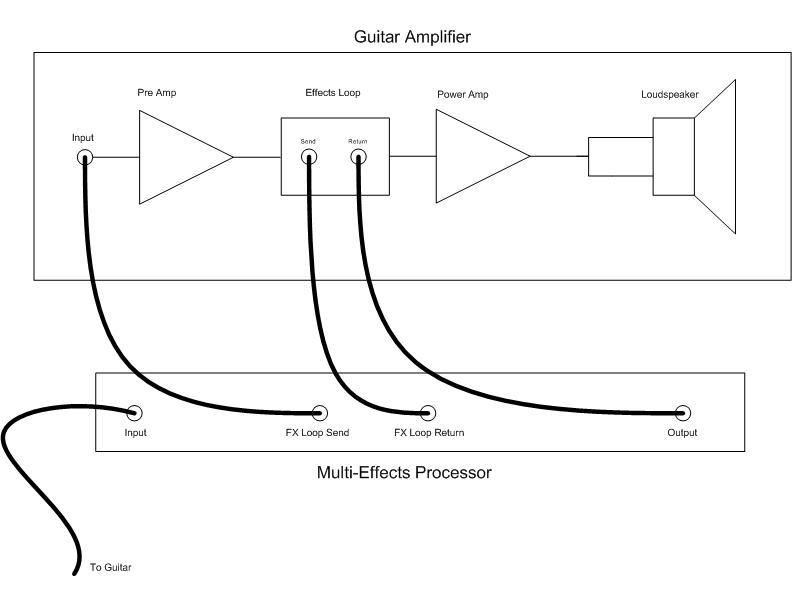
The first things you will notice is that your amplifier is typically made up of several sections. There's a Pre-Amp section, which is largely responsible for creating the distinctive tone of your particular brand of amplifier, and a Power Amp section, which is responsible for amplifying the Pre-Amp signal to the required volume. In between the pre-amp and the power amp, you have an effects loop, which is designed to allow you to place effects between the pre-amp and the power amp. This is very a very simplistic view though, as the power amp section does contribute to the overall tone of the amplifier, particularly in valve amplifiers, but should you remove the pre-amp from the circuit, you are largely left with a colourless amplified signal. If you take your guitar and plug it into the Return jack of the amplifier's effects loop, you are essentially bypassing the amplifier's preamp and passing the signal straight to the power amp. Try it, and behold how horrible and lifeless your guitar sounds.
Now, the beauty of the 4 Cable Method of connecting a multi-effects processor to your amplifier, as that you are able to isolate your own amplifier's preamp, which remember is responsible for most of your amplifiers characteristics, within the multi-effects processor's effects loop. Look at the diagram again, you will see what I mean.
So what would typically happen if the effects loop on the multi-effects processor was switched on, is that the signal would flow from your guitar, into the input of the multi-effects processor, then out the Send of the Multi-effects processor's effects loop, through your own guitar amplifier's pre-amp, out the amplifier's Effect's loop Send effects loop connection back into the multi-effects processor and then back to the amplifier's power amp via the amplifier's effects loop return.
If you then switched off the effects loop on the multi-effects processor, the signal would flow from your guitar
into the input of the multi-effects processor, then out the Output of the multi-effects processor into the Return connection of the guitar amplifier and to the power amp. IN this scenario, there is no preamp in the circuit, so if you have all effects switched off on the multi-effects processor, it should sound as if you've plugged your guitar into the Return socket of the amplifier.
Make sense so far?