I just got my Larrivee back from McGibbon's. It's been in there for a pickup to be fitted. I wanted something a bit better, a bit more
believable than the usual under-the-saddle system.
I discussed options with Andy. LR Baggs offer two system with dual sound sources. One is the "I-Mix" the other is the "Dual Source". Both are based around the Baggs "Active Element" system. I-Mix marries the element with the Baggs "I-Beam" transducer (that Keira recently had fitted and gave us her opinion on). This is a contact system that fits under the bridge plate. The Baggs "Dual Source" marries the under-the-saddle element with an internal condenser microphone. In the Baggs system this is not mounted on a goose-neck; it is enclosed in a little block of foam rubber and is mounted with velcro inside the back of the guitar. After some musing, discussion and googling I opted for the "Dual Source" system.
The first thing I want to note about this system is that it's non-destructive, non-obtrusive (as are several other Baggs systems).
Consider this photo...
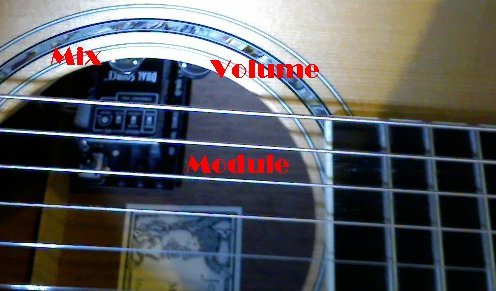
Here you can see the pre-amp/mixer module and the control unit. The "black box" is mounted inside the guitar, on the back, with velcro. The controls (volume and mix) are two little thumb wheels mounted inside the sound hole. The microphone is not visible in this shot. It's mounted inside the back and (in this case) beneath the bridge plate. The battery is installed in a little bag that can be pulled out through the sound hole. So there's no need to cut any part of the body work away.
You don't
have to mount the mic beneath the bridge plate. You can experiment with placement. However Baggs recommend beneath the bridge plate and slightly towards the bass side as a default. Mark, the technician who fitted the system, said that Baggs do a lot of test installations during their development phase and he finds that you generally get the best results with their default installation. Baggs also pre-set the various controls on the black box. You can, of course, modify these but again Mark chose to go with the default settings - though one was eventually tweaked (more later).
OK... how does it sound? I made a quick recording. This is with a lead straight into my PC's sound card. I used Audacity to record but added no effects or EQ. Let me just explain what's going on here. The system was installed in mono mode. In this mode the under-the-saddle element is always on, and the "mix" control progressively adds more of the microphone to the signal. In this recording I start off with the mix set for element only. Then I pause and dial more mic in. You can hear the colour and depth that this adds.
http://www.box.net/shared/t3g617ioje
One of the tweakable controls on the black box is the microphone gain. By default this is set to 7. Mark took this back down to 3 at installation time. After testing we decided to turn it down a little more so that mix control would offer finer control.
We found that you actually don't want a lot of mic. The sweet spot, as Mark has the system set up, is round about 1/3 travel of the mix control. With too much mic things started sounding echoey - this was not feedback, it started to sound like the guitar was being played in a big empty hall. So you don't need to go all the way with the mic - you want just enough to add some depth and air to the signal from the element.
We were testing with a very nice AER amp, but even straight into the sound card you can hear the difference that the mic makes.
The system is easy to operate too. Just the two controls in the sound hole - master volume and mix.
There is a phase switch on the black box which would be easily reached with a screwdriver or knitting needle. This puts the mic out of phase with the element. The default is in phase, but the switch (easily reachable if the system is installed by somebody sensible) is there in case you are struggling to tame feedback.
Very nice system. Just what I wanted - sounds a lot more like an acoustic guitar.
This can also be fitted in nylon string guitars.
For more details see
http://www.lrbaggs.com/dualsource.htm