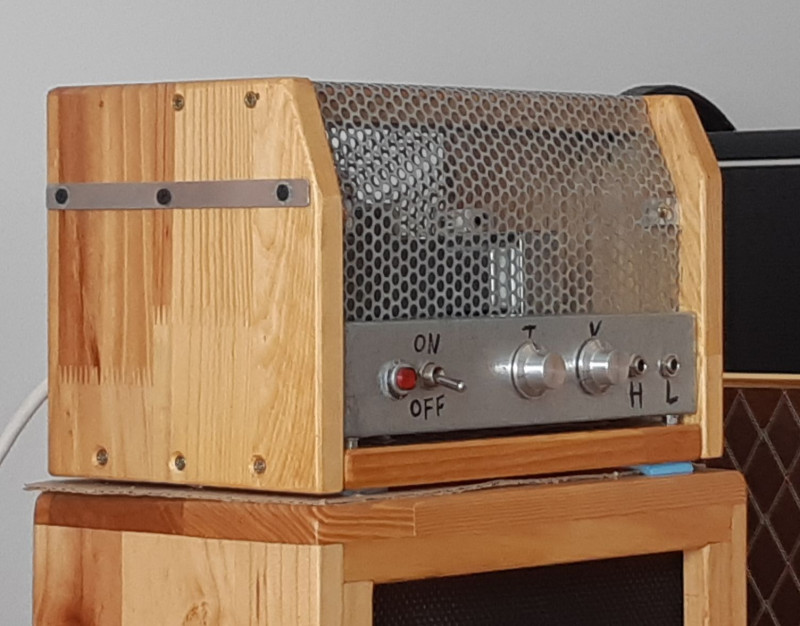
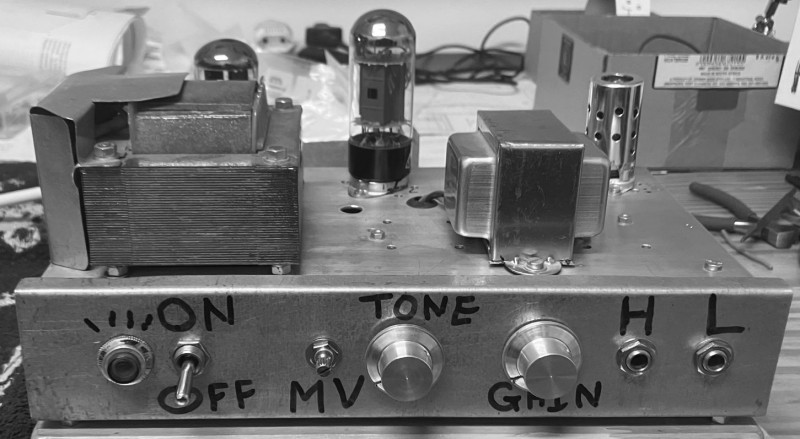
I installed JJ 6V6S and JJ 12AY7 tubes. It does make a difference. (The original 12AX7B tube caused a short “buzz” at startup, when the system came on song after about 7 seconds.)
I find the overdrive to be smoother and more pleasant, at the same volume settings. The amp is still too loud to play with overdrive, though, but the sound is now less “distortion” and more coherent at around ¾ volume. Still a mess at full blast. Not much difference in available volume.
I am also changing to a 240 VAC to 222 VAC bucking transformer for the AC supply. With this, I measure the following all over the amp:
5U4GB RECTIFIER + JJ 12AY7 AND JJ 6V6S TUBES
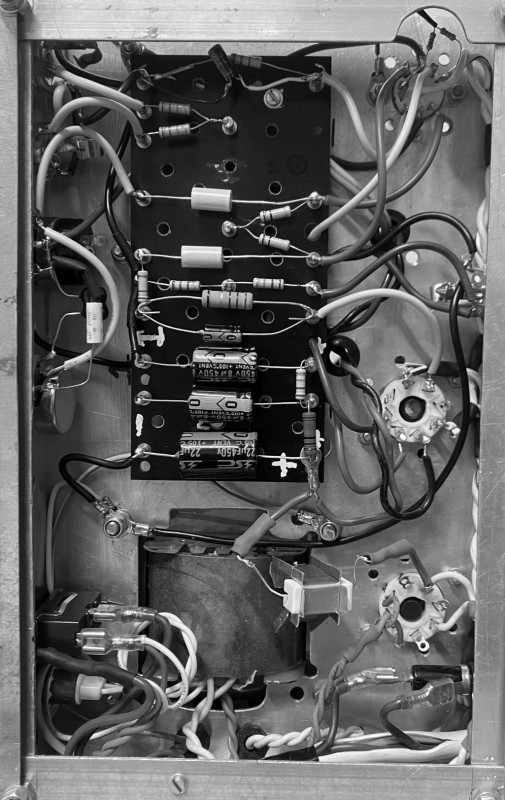
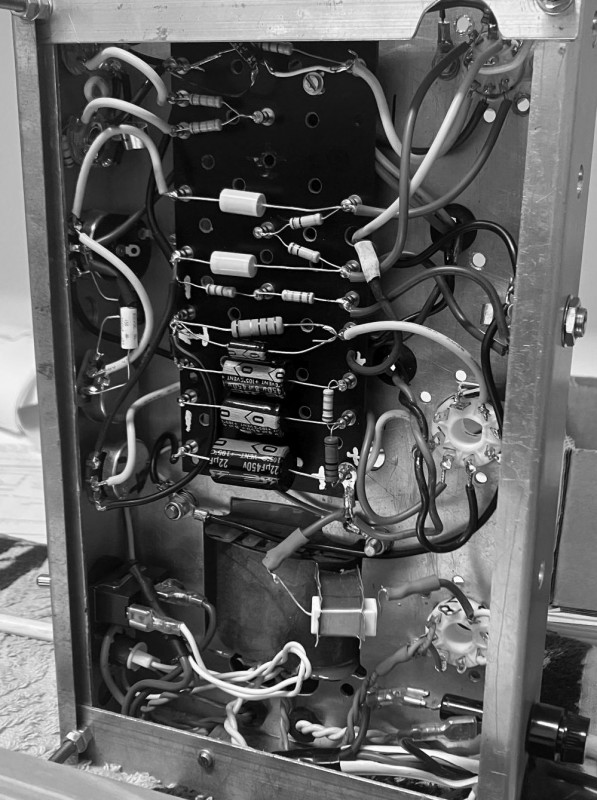
2 x 1KOHM 5 WATT DROPPING RESISTORS IN PARALLEL TO B+ (495 OHM DROPPER)
INPUT: 222 V AC
703 V AC ON DIODE PINS FROM POWER TRANSFORMER
22 V OVER DROPPER RESISTORS (44 mA)
B+: 377 V DC
CAP 2, AFTER 10 K RES (B+2): 322 V DC
CAP 3, AFTER 22 K RES (B+3) 264 V DC
6V6S PIN 3 – PLATE: 366 V DC
6V6S PIN4 - GRID 2: 322 V DC
6V6S PIN 5 – GRID 1: 10 mV
6V6S PIN 8 - CATHODE: 19.9 V DC ( 40 mA)
19 V OVER 470 OHM RESISTOR (40 mA)
6V6S IDLE DISSIPATION: 13.8 WATT
12AY7 PIN 6 – ANODE/PLATE 1: 132.5 V DC
12AY7 PIN 1 – ANODE/PLATE 2: 135 V DC
12AY7 PIN 8 – CATHODE 1: 1.85 V DC
12AY7 PIN 3 – CATHODE 2: 1.8 V DC
DIODE FILAMENT: 4.93 V AC
TUBES FILAMENT: 6.3 V AC
Could be the amplifier sounds brighter like this. Might also have less breakup at the same volume setting.
I have a “FENDER “CHAMP-AMP” LAYOUT MODEL 5F1” diagram indicating B+ as 340 V. It also shows 150 V at the 12AX7 plates (never had close to that). Not sure how this compares to the 135 V I now have for the 12AY7?
Now to “fix” B+.
Voltages sorted, I hope. To reduce B+, I snipped off one of the two 1000 Ohm droppers, leaving me with one 5 Watt 991 Ohm dropper resistor between the diode and the B+ terminal. I measure the following:
240 TO 222 VAC BUCKING TRANSFORMER
5U4GB RECTIFIER TUBE + JJ 12AY7 AND JJ 6V6S TUBES
1 KOHM 5 WATT DROPPING RESISTOR IN PARALLEL TO B+ ( 991 OHM)
DROP 40 V OVER 991 OHM DROPPER RESISTOR (40 mA, 1.6 WATT)
B+: 341 V DC
CAP 2, AFTER 10 K RES (B+2) 293 V DC
CAP 3, AFTER 22 K RES (B+3): 241 V DC
6V6S PIN 3 – PLATE: 330 V DC
6V6S PIN4 - GRID 2: 292 V DC
6V6S PIN 5 – GRID 1: 5 mV
6V6S PIN 8 - CATHODE: 17.9 V DC (38 mA)
17.7 V OVER 470 OHM RESISTOR (37.6 mA)
6V6S IDLE DISSIPATION: 11.73 WATT
12AY7 PIN 6 – ANODE/PLATE 1: 120 V DC
12AY7 PIN 1 – ANODE/PLATE 2: 125 V DC
12AY7 PIN 8 – CATHODE 1: 1.6 V DC
12AY7 PIN 3 – CATHODE 2: 1.7 V DC
DIODE FILAMENT: 4.9 V AC
TUBES FILAMENT: 6.27 V AC
Comparing this to the mentioned Fender Champ schematic specifications, I am at the correct design voltages, but the 12AY7 cathodes have higher voltages than specified for the 12AX7 in the diagram (1.6 V/1.7 V vs. 1.5 V specified) and the plate voltages are lower (125 V / 120 V vs. 150 V specified). I am not going to worry about this now. Can I take it that the 12AY7 runs pretty cool biased, with low gain?
The 1 K dropper is supposed to dissipate only 1.6 Watt at idle, but it is hot to the touch. Will clamp on a bit of aluminium heatsink, will see if I can bolt that to the chassis. Ideally require a 10 Watt resistor now. Or two 500 Ohm 5 Watt resistors is series. Less heat per unit.
Question: At startup, if I probe the B+ terminal, the voltage starts to show after a second or two, goes in a varying way up to 481 V, jiggles around some, and finally settles on the B+ value?
I the interests of full disclosure, I measured B+ with a guitar plugged in and strummed hard. No sag at B+1. B+2 (293 V) does drop a few Volts when strumming hard, and B+3 (241 V) drops too, but less.
If I understand correctly, I can replace the 1 kOhm B+ dropper with a chassis mounted 40 V or so Zener, cathode to chassis, anode to center tap. I have read that this size Zener might induce noise, which can be reduced with a 0.1 microFarad capacitor over it. Your experience?