Malkav
When I ordered mine I got them through the all parts agency which at that point was something Music Connection were doing.
I've had them in my 6 and 7 strings and getting the balance can be a bit tricky, if they're not correctly balanced they hinder the motion of the bridge a bit so you'll know if you don't have it right.
For Ibanez I believe you'd generally need the small claw variant as those are what my guitars used, but they were Prestiges so I'm not sure if the block dimensions would differ.
Also the little thumb screws are bastards and can sometimes work their way out of the chassis if left untightened, some people use little springs or pieces of tubing to put counter tension on them to relieve this issue, but for home use you should be okay ?
NorioDS
Damn. Sounds like a pain in the ass.
Maybe I should try the block of wood thing first. Don't want to end up buying the wrong one or fiddling with little bastard-screws ?
Nick-le-Rock
Norio wrote:
I'm really keen to have one of these fitted to my floating bridge mainstay, my Ibanez JS100.
I'll settle for a block of wood if I have to but would much rather have the flexibility of a Tremol-no.
Any ideas?
Hi Norio
About a year and half ago I was searching for a similair product for my JEM. I ended up fitting two ESP Arming Arresters(adjuster). It works like a charm, and wasn't too expensive. I ordered them on eBay from a music shop in Japan. I think I waited two weeks. They are WAY better than the knockoff Backstop I got from Thailand.
Let me know if you want to know more.
Nick
NorioDS
Thanks Nick, I'd love to know more.
I saw this video and it looks like it'll definitely do the trick:
=
Mind posting a pic of what yours looks like with the 2 goodies inside the cavity?
Nick-le-Rock
Sure, Norio
Here you go!
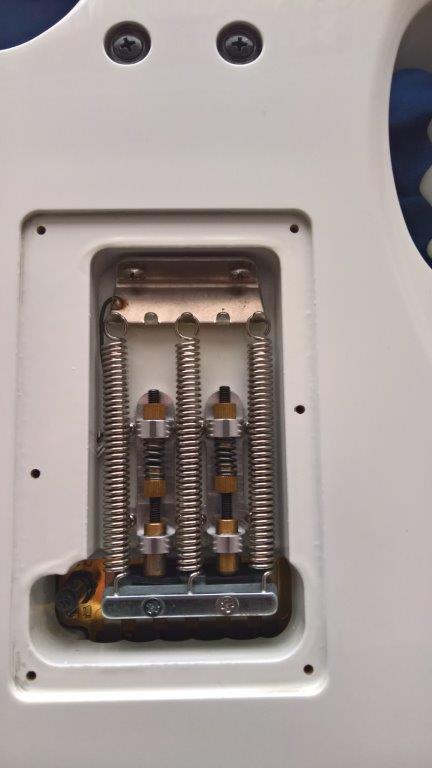
NorioDS
Thanks! It looks dead-easy to install, too.
Nick-le-Rock
Norio wrote:
Thanks! It looks dead-easy to install, too.
That it is. The hardest part is the setup, but that's not too hard either. If you are used to setting up your own floating bridge you'll figure it quickly.
And you don't HAVE to install two. One will do for most people.
Malkav
In fairness the ESP Adjusters and the Tremol-no do two different things entirely, so they're not really alternatives to each other.
Nick-le-Rock
That is very true. I have however found that some people look for the Tremol-no, thinking it does a similair job to the ESPA's. This is why I suggested just 'another' product. In researching one would quickly find the benefits and drawbacks of both systems.
NorioDS
@Chad, @Nick: Please enlighten us. What do they do?
Or what are the best uses for each?
Nick-le-Rock
I have no first hand experience with the Tremol-no, but as far as I understand it has three modes; Free floating bridge, Dive only and Fixed bridge. am I right, Chad?
What I can tell you is WHY I decided to install the ESPA's. I want to be able to play unison bends or doublestop bends in tune, but keep the floating bridge functional. This does, however, mean that the trem action 'stiffens' up considerably, so if you are a big fan of flutters, don't even go there.
NorioDS
Thanks @Nick ?
Yeah that sounds great. I hate trying to do unison bends on any of my floating bridge guitars.
It also sounds like the Arming Adjusters will help with changing the tuning quickly? (Well quick for a floating bridge.)
That's also right up my alley.
I can't say I use my tremolo bar for much more than a bit of vibrato, really. Especially on bends because my vibrato on bends is utter shyte ?
Malkav
Norio wrote:
It also sounds like the Arming Adjusters will help with changing the tuning quickly? (Well quick for a floating bridge.)
Nick is dead on, but the arming adjusters unfortunately won't help you with changing tuning quickly, if you were to say put your low E down to D it still requires that the springs balance out, in that respect a locked down tremol-no would be best. The Tremol-no will only assist in keeping double stop bends in tune if it is fixed or in drop only mode.
Nick-le-Rock
In theory it is possible to use the Arming Adjuster for alternate tunings, but you would have to use .009 strings and stiffen up those cavity springs a lot. If alternate tunings on the fly is more important that full use of your floating bridge, the Tremo-no would definitely be a better bet. I use my trem sharp AND flat, so the Tremol-no wasn't an option for me.
NorioDS
Thanks fellas ?
Edwin at JD Kustom has put in a wood block for now. I'll mess around with that for a while and then, if I'm not happy, I'll probably try a Tremol-no next.
Way I figure it, it should be easiest to do this with a Tremol-no: Lock the tremolo, change tuning, unlock the tremolo.
I'm really trying to bring down my number of guitars while still having fun playing everything from Satriani to Buckcherry in Rocksmith ?
Malkav
Norio wrote:
Way I figure it, it should be easiest to do this with a Tremol-no: Lock the tremolo, change tuning, unlock the tremolo.
That won't work, literally nothing on the market will do that for you, the springs need to balance. You can lock the trem and tune to your new tuning, but the moment you unlock it everything will get knocked out of whack. You can lock the trem, tune to your new tuning, then tune back to your original tuning and that'll be fine, but what you're asking for is literally unachievable.
Nick-le-Rock
Chad is right. Balance is everything with a floating bridge.
However, I can tune down to dropped D without affecting the tuning of the other strings. In fact, I can remove the top string and then my B strings only sharpens with 20c, so...challenge accepted!! @Norio, what are these alternate tunings you refer to. Then I will test to see how much my trem actually drops when tuning to those tunings, and how long it takes. One of the problems you will have live, though, is undoing the locking nuts, unless play without them.
@Chad...for the most part I agree with what you say. Everything has to stay in perfect balance, but this will be an experiment which I haven't performed yet, as I always play standard, so let's see how far it goes.