Mike wrote
PJH wrote
The original question was "Do you consider Tokai guitar counterfeit"
The definition in the dictionary is: "made in imitation so as to be passed off fraudulently or deceptively as genuine".
Tokai puts their own name on the headstock.
Therefore the answer is No, they do not make counterfeit guitars.
They make copies or maybe "replicas" (a name that I prefer).
Case closed.
Case very much open, I'm afraid.
The definition in your (or any) dictionary is irrelevant. If this is a legal issue being raised in SA than it's the definition under South African law that counts. And I don't—like, it would appear from the comments, everybody else—have a sufficiently in-depth knowledge of that to answer the original question.
I certainly consider many Tokai guitars to be shameless rip-offs, even though they can also be very,
very good musical instruments. Whether that is legally right or wrong
in this jurisdiction, is another matter entirely.
"Analogous" examples from other jurisdictions are, frankly, unhelpful, as is the repeated stating that they were not the first and a very far from being the only shameless rip-offs on the market. As are comments seeming to suggest that the high quality of the instruments somehow diminishes the rip-off aspect.
I do know that South Africa has been beefing up its anti-counterfeiting laws, since the country is a major dumping-ground for counterfeit goods, and it could be that Gibson (or its representatives) has spotted a crack that could trip Tokai (or its representatives) up. If that's the case and if the Gibson side is correct, then Tokai guitars are—in South Africa—counterfeits; if not, then they are not. That's how the law works. Whether any of us "consider" them to be counterfeits is pretty much irrelevant...
I have a reasonable knowledge of counterfeit laws in SA, in fact all SA law.
Tokai being classified as counterfeits is not debatable, they are not counterfeits.
Gibsons patents expired 14 years after they were registered, that's a few decades ago.
Gibson do not have trademarks for their body shapes in SA.
They have two trademarks both registered in SA in 1975.
The SG "Standard" scratchplate shape and the 'bell shaped truss rod cover'.
I don't think Gibsons legal team have spotted any cracks...I'll tell you why I say that.
In my founding affidavit to Gibson I mention the Fender Trademark Applications case in the USA that started in 2004 and ended in 2009...(btw, practically 100% of guitarists around the world don't even know about this case).
I can
mention the Fender Trademark Case in my founding affidavit but the law doesn't allow me to actually provide proof/evidence, unless they (Gibson) themselves bring it up in their affidavits, then I can by law supply the proof when I reply in my following affidavit.
In my founding affidavit I mention that in 2004 Fender (FMIC) applied for trademarks on the Stratocaster, Telecaster and P-Bass shapes in the USA.
I mention that the trademark applications were opposed by 17 of the worlds biggest guitar companies including Tom Anderson, John Suhr, ESP, Peavey, etc, etc...I mention all 17 opposers.
I also mention that in 2009 the United States Trademark Trial and Appeal Board ruled in favour of the 17 "opposers" on the grounds that after 50 years the shapes are now considered "generic" in the guitar world.
Thus Fender did not get trademarks on their body shapes and any guitar company in the world can make guitars with those shapes.
The head of Gibsons legal department in his "answering affidavit" replied to my mention of the Fender Trademark case saying, "this is unsubstantiated heresy and no evidence of such a case exists".
Well, that's odd, on the 31/3/2009 Gibson themselves published the result of the Fender Trademark case on their (Gibsons) website, yet the head of their legal department didn't know such a case existed? ???
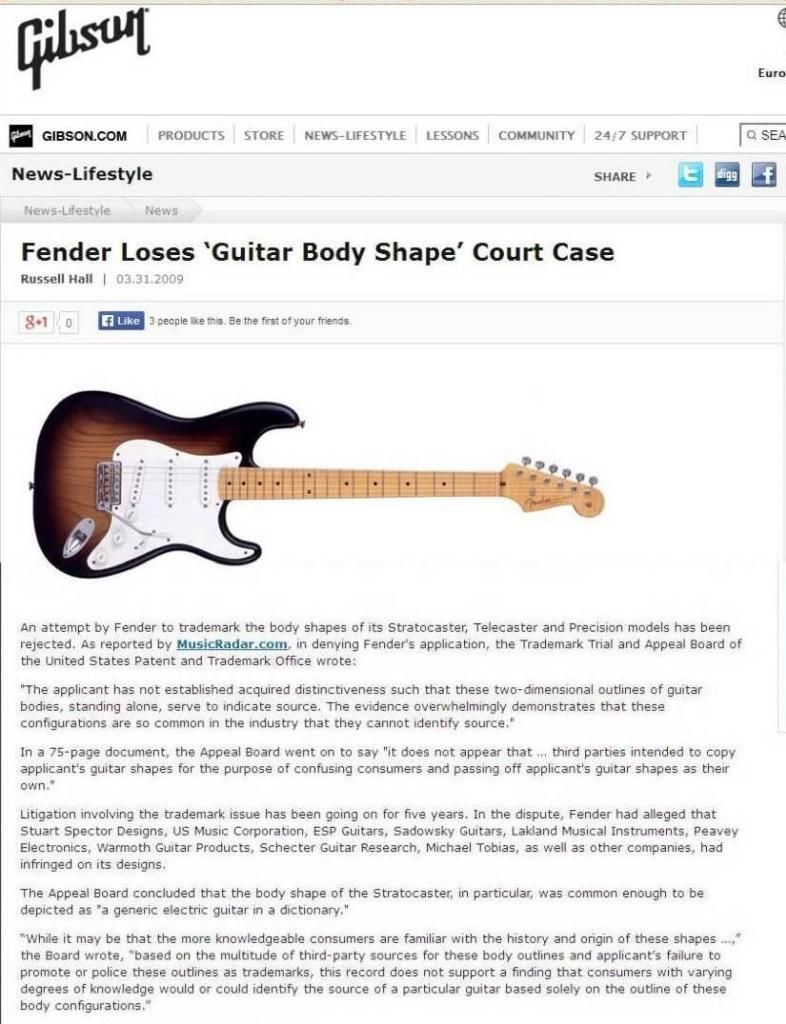
Here's the full transcript of the Fender Trademark Trial...this is now introduced into my evidence because they brought it up and claimed it doesn't exist.
https://www.dropbox.com/s/9cwi5n6f4cbsdhv/Fender%20Trademark%20case%20USA.pdf?dl=0
Guitarists who own all sorts of different guitar brands are fine with the fact that Fender the most iconic guitar company in history were refused trademarks by the USA Trademark Council, but the same decision shouldn't apply to Gibson in South Africa?
The Fender Trademark Case is the "precedent" you speak of.