ezietsman
haha, yeah. I was like "please don't blow, please don't blow, pretty pleeeeaaaase"
Also, I plugged in the guitar and put it down, switched on the amp and got out the multimeter to see if it will zap me or not. That suggested it wouldn't. Deep breath, strum. Nothing.
Turns out I missed the wire going from the rectifier to the first filter cap. Put it in, 5 minutes later, went through the motions again, and low and behold, it worked! ?
Nothing like turning a newly built amp on the first time.
TomCat
As a safety precaution wire a 60W lamp in series with the live of your power lead to the amp.
This acts as a current limit should you have done something wrong and the amp tries to draw a lot of power from the mains.
If the lamp does not light up on switch on, all is well..........from a power perspective.....If the amp is working you can remove the lamp.....
singemonkey
Hope ShaunF has practised up his Randy Rhoads licks. This must be the appropriate thing to test the amp with:
=
shaunf
I just have one thing to say
IT'S ALIVE!!!!!!!!
*insert evil laugh*
Kalcium
shaunf wrote
I just have one thing to say
IT'S ALIVE!!!!!!!!
*insert evil laugh*
Awesome!!! How does it sound!? Any issues?
shaunf
Got a few issues.
VVR not working. I suspect the MOSFET may have shorted. Got spares, but don't have spare Zener diodes, so I have removed the whole unit for now until I get some zeners next week and will replace them and try again.
The standby switch seems to have failed too. Doing a continuity test and its on all the time. Have just swapped it out with a spare one I had fortunately.
Otherwise, besides those 2 things, it works great and is stable even without any grid stopper resistors installed. No hum to speak of, no oscillations, and hiss is tube dependent. I've been going through my tube stash this afternoon trying to find one with very low microphonics for v1 which is proving a challenge. I prefer tested all my tubes for microphonics in my JMP and even those ones that tested well are showing up mechanical noise in this amp. I've got a good set in there now, consisting of a NOS Siemens in V1 and some pre war NOS Ei's in V2 and V3 and it sounds nice, although I haven't really wrung its neck yet for fear of being evicted. I've got a set of new Winged C EL34's in it for the time being, until I am 100% happy that everything has settled in, after which I'll drop in a set of NOS Siemens EL34's.
I'm pleased with the sound thus far. Very different to my Marshall's. Very open and direct sounding. It's hard to explain, you kinda need to hear it. It's like there is nothing in between the guitar and the sound coming out the speaker. It also responds dramatically to different preamp tube combos. Different combos alter both the tone and noise levels far more radically in this amp than any other I've put the same tubes into.
From here on out, it's tweak tweak tweak until its perfect.
makepeace
NICE! man super jealous..
sho, those first couple of seconds after startup.. first time i sat there poking the strings with a broomstick (even after measuring sig to ground).
been having withdrawls and completely re-arranged my spring verb today. i think i'm gonna build a variation of one of these next..
you have to put some clips up when all's sorted!
JeremyE
shaunf wrote
It's hard to explain, you kinda need to hear it.
Hmmmm...I dare say some sound clips may help with this statement ?
shaunf
I'll try get something recorded at some stage, but all I have to record on is my cameras mic, or the built in mic on my iPad. Perhaps one of the other durbanites has access to better recording facilities?
ezietsman
Silly question. I assume you bolted the mosfet to the chassis (so that the chassis will act as a heatsink). Did you install the mica washer (very thin transparent thing) between the mosfet and the chassis and did you use the little plastic thingy that keeps the screw isolated from the mosfet?
Congrats on your new amp! 8)
shaunf
I installed the mica pad but didn't get anything that isolates the bolt. I bought spare mosfets too and each of them only has the mica pad in the packet.
I figured I installed it too close to the underside corner of the chassis lip and it shorted against the corner but now I'm concerned I am missing something and its the bolt that's doing it. Do you perhaps have a picture of this plastic thingy?
Gearhead
You can get plastic bolts at the better hardware store and/ or webshop.
In case you can't find, just use any plastic/rubber grommet or washer to do the job. It is absolutely imperative that you do not short the FET.
shaunf
Thanks Gearhead. I just ordered some nylon nuts bolts and washers from RS. Will use these to mount it next time.
ezietsman
If the bolt connects the mosfet to the chassis then it just acts as a short and the VVR will not work at all. Also, you MUST put heatsink paste between the mica and the chassis and between the mica and the mosfet. Else the mosfet will likely overheat and fry and once again turn into a dead short, rendering it inoperable. A plastic bolt will work just fine I guess.
shaunf
Thanks ez. What I looked at the bottom of the mostfet, there is a shiny metal part, and I figured that is what must be insulated from the chassis. There is a gap between this metal and the hole, all around the hole, so I thought a standard bolt would be fine, as it comes nowhere near the metal part underneath the mosfet.
There seem to be 2 schools of thought regarding the heatsink paste. The manufacturer of the VVR strongly advised against using paste as he has encountered many of the commercially available pastes that are actually conductive at very high voltages, and receives a high number of comebacks that he can directly attribute to the use a number of different heatsink pastes. Some do work, but you need to ensure you have the right one.
He says that as long as the mica pad is in place, then the aluminium chassis I am using is heat sink enough.
ezietsman
Well, if the Mosfet fries, it will does act as if there is no VVR at all, running your amp at full voltage (I think). I know a guy than knows a guy that went through multiple mosfets in his 18 watt amp because he didn't use the paste. There will be air trapped between the mica and the mosfet, air doesn't conduct heat. Also, if your chassis is steel it will not conduct heat as well as aluminium (nowhere near as well), so you probably need to do as much as you can to get rid of the heat if your chassis is steel. Mine has been running for more than a year without a hitch (touch wood) with the paste in. My chassis is aluminium. Personally, I've been advised by multiple engineers that the paste is the way to go. Same thing as on your computer's CPU and the same thing they use in air-to-air missiles ?
YMMV.
Edit: Also, the metal casing of the mosfet is is a working part, so that needs to be electrically isolated from the chassis, hence the plastic bolt / washer thingy that goes into the hole before you put the bolt in. Make sure nothing touches that either.
2nd Edit: I see your chassis is aluminium. Maybe you'll be fine. Mosfets aren't too expensive so maybe worth an experiment. Good luck!
shaunf
The hall bros who supply the VVR I am using specifically say to avoid the pastes used on computer CPUs. That paste works fine in that environment with components that work at low voltage but can conduct under the high voltage scenario the MOSFET is used in.
The strange thing is you refer to this plastic insert. I have 3 unopened mosfets and none of them have anything in the packet except the MOSFET itself and the mica pad.
Well I'll monitor things and if it doesn't work, I'll try the paste. Nothing to lose, but also don't have an endless supply of mosfets.
ezietsman
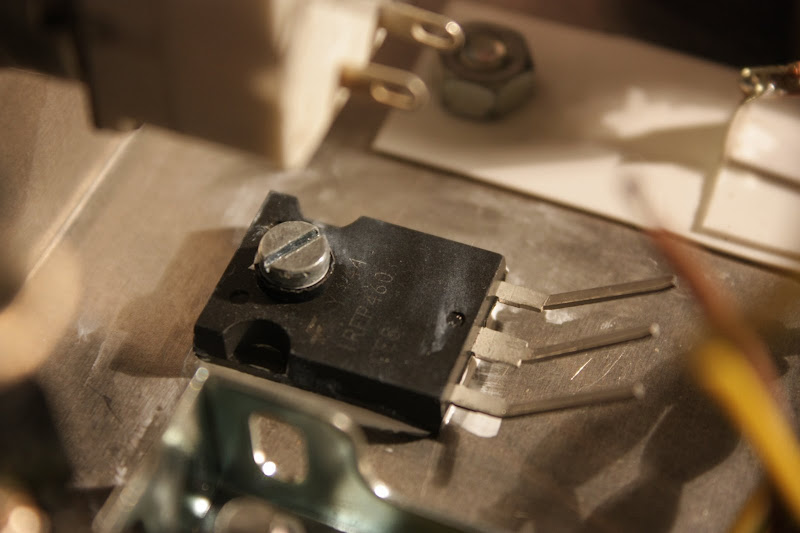
The little black plastic thing you put into the mosfet before the bolt goes in.
I'm not sure about the heatsink paste. I asked for heatsink paste at communica, they gave me a tube of stuff and I used it.
Mine says the following in the tube:
"
Unick
Silicone Heat Transfer Compound"
I just naively got the first thing they offered. Maybe I'm the lucky one.
shaunf
ez wrote
The little black plastic thing you put into the mosfet before the bolt goes in.
I'm not sure about the heatsink paste. I asked for heatsink paste at communica, they gave me a tube of stuff and I used it.
Mine says the following in the tube:
"
Unick
Silicone Heat Transfer Compound"
I just naively got the first thing they offered. Maybe I'm the lucky one.
Wierd that my mosfets don't have that insert.
Just did some research on these heat sink pastes. It seems like there are 2 distinct categories - electrically conductive and non-conductive. I'd say that you were lucky and from what I can see most of the silicone compound ones are normally non conductive. I've just ordered some too, but not a silicone based one, but rather a metal oxide based one that has a very high dialectic strength and doesn't creep like the silicone ones do.
AlanRatcliffe
Silicon or ceramic heatsink pastes are non conductive. Other types of computer pastes like Arctic Silver have metal in the compound, which is fine for a processor, but not for this application..