Sorry for the delay to the article regarding Microphones. Work sometimes can be a headache..! So as I said in the previous set up article, this one will be about Microphones. When you look into the whole process of recording and mixing music, there are a lot of factors to consider. You have your system, mics, monitors, mixing techniques and most importantly, your ears. (We wont go into taste, because Britney Spears' producer might stumble onto this, and then I wont be able to get a platinum selling album with no effort needed from my side).
Most often though, people make the wrong decision purchasing microphones and then wonder why they are not getting the sound they want. And this is where the water gets murky, because, as with most of us, budgets are tight and you have to get something that will work in most situations. So join me into the netherworld of microphones.
Microphones mostly fall into 3 categories.
* Dynamic
* Condenser
* Ribbon
Now because we mostly are looking at home to semi-pro recording I'm going to focus on the 2 main ones you'd encounter in your search for capturing that guitar or vocal signal that'll send your music into the stratosphere. ( Just had to give a Strat reference )
DYNAMIC
Dynamic microphones can be, at its most basic be described as 'self-powered.' The reason I say this is because you don't need an external power source to make the mic work after you've plugged it into your pre amp or mixer. You just plug in, turn up the gain on your mixer/pre amp and you're A for Away.
Dynamics work on the principle, that the microphones internal pre amp receives its power from the mixer it self. Thus its a no mess, no fuss piece of equipment.
What makes a dynamic a very good choice as a first mic, is it's versatility. From guitars, vocals, drums to some more interesting uses. These mics normally have a high SPL (sound pressure level) rating, which makes it ideal for recording loud sources like a heavy handed drummer (thats basically every drummer I know), or that very nice sounding Marshall stack cranked to 11.
There are drawbacks with dynamics though. The sound.. Even though they are quite often used on stage, recording with them does tend to be a pain in the backside (there are under aged people on this forum). These mics tend not to have a nice top end range. Meaning that you end up not getting a very 'open' sound.' Most vocals wont be recorded with dynamics, but there have been cases where using a SM58 (Shure) actually proved to be a better choice than a condenser or ribbon. At the end of the day though it all comes down to that old saying 'Horses for courses!' And you might find that using one proves to be a better bet in your situation than using a condenser, tube or ribbon.
CONDENSER
In the last few years there has been an explosion of the number of condensers that have flooded the market. Companies (esp. from China) have taken the market by storm, and has proved that you don't have to pay an arm and a leg for a good condenser mic.
If you had to state the one obvious difference between a condenser and a dynamic mic, it would be that, whereas dynamics are 'self-powered', condensers need external power to operate.
There are 3 main ways to power a condenser.
* Phantom Power (+48V DC)
* External power supply
* Batteries
Let's first have a look at the batteries. Condenser mics that are powered by batteries are known as Electet-Condensers. What the battery does, is that it provides the necessary power to the pre amp of the mic to function. So where a dynamic receives it's 'power' from the desk, these need additional power to be able to function. (This goes for all condensers).
These were quite common at the lower end of the market, but I havn't seen these for quite some time.
Some condensers need an external power supply. These power supplies carry power to your pre-amp, and receives it's power from a normal mains power cable. In some cases the power supply also acts like a preamp for a mixer. In these cases you can expect to pay a pretty penny for them.
Phantom power... Phantom power is that little switch that sits on most mixing consoles, labeled as +48VDc. What happens here, is that as soon as you've plugged in the mic, you hit the switch, and the desk sends a Dc voltage to the microphone to power the pre-amp.
A quick look at electricity theory: The current you receive at home is an Ac signal. That means that the current alternates between a + and - signal, which is why Ac stands for 'alternating current.' Most home appliances work on Ac currents. However we all have come across gear with AC/DC converters. We mostly find them on guitar pedals, external hard drives and lap top power supplies. This just means that the AC (alternating current) is converted to DC (direct current).
To get back to the phantom power.. The power to the mic is sent as a 'direct' voltage via one cable (the 'cold') and then sent back via the shield (neutral) cable. This is done so that there is no external interference to your audio signal when power for the condenser is needed.
A miss conception for all microphones in general is that they work on 'stereo' connectors. A mic cable is generally described as a balanced cable, which means that there are 3 wires running through out the cable. A positive (hot), a negative (cold) and a neutral (earth).
Now even though this in theory does describe a stereo signal (like we all understand headphone jacks), this is not a stereo signal!! I can remember how many times I've had to explain to someone this fact after they recorded something and then ask 'why is my recording mono?'
MICROPHONE POLAR PATTERNS
When getting into recording, it's a good idea to know what 'pattern' your mic is. By pattern I mean, the pick up direction. There are 3 patterns that you'd come across in your trips through the murky underworld of microphones.
These are:
* Cardioid
* OmniDirectional
* Figure of eight
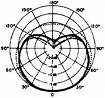
CARDIOID
Cardioid is your most common pattern. To explain it in a very easy way is to say - The direction you point your mic is the area it'll pick
up.
This is your standard polar pattern and, in some ways your most effective microphone pattern to use. The reason I say this, is because we all don't have access to a great sounding room with the proper acoustic treatment, these mics will help to not 'color' the sound with bad room acoustics. Don't get me wrong, you get room 'coloration' no matter what you try. But, these help to keep it to a minimum if you pay attention to micing technique.
You however need to pay attention to how you use the mic, and experiment with various placement options. Not just with the microphone, but also with your instrument placement. e.g where you sit in the room, what way your instrument is facing.. It all comes down to, good technique and the will to experiment.
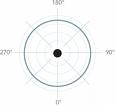
OMNI-DIRECTIONAL
Omni's pick up from all around.
This really is only an option in a great sounding recording space. You get a very 'open' sound in this pattern, and this is where you can get into trouble when recoding in a room which has acoustic problems e.g. too much reflective surfaces, too much or too little bass etc. But, after all this is said, it's worth trying this out, sometimes you'd be amazed with what can happen..!
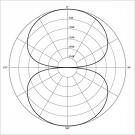
FIGURE OF EIGHT
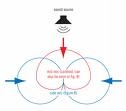
This is a 'funny' pattern. This polar pattern is known for it's ability to pick up signal from 2 sides. An easy way to think of it is to say you put 2 cardioid microphones together facing in the opposite direction.
As you can see from the figure above, it looks a lot like a cardioid pattern on opposite sides. This kind of pattern is mostly used with the Mid-Side (MS) micing technique. In short, MS is basically a Fig.-of-8 mic combined with a cardioid.
A lot of people use this to record drum overheads, and some other sources where you want a wide stereo signal combined with a focused centre channel.
OTHER THOUGHTS
One thing to look at when buying a mic is its frequency response. Some mics are tailored for specific signals. These can vary from ones built for kick drums and bass to mics used almost exclusively for vocals. At the end of the day, you have to go look for something that will suit your needs. Out of versatility, most people will buy 2 mics. A dynamic, cardioid mic, and a condenser cardioid. Most cardioids do offer selectable polar patterns. But that comes at a cost.
But to have access to these 2 different mics will be of great help to your recordings and quality.
There are quite a few companies that now make affordable condenser mics. Just from the top of my head I can think of 2. SE Electronics and Studio Projects. And the great thing is, that they wont break the bank if you're looking to supplement your recording setup.
If you have questions about anything covered or not covered regarding microphones, mail me and I'll try and get to you ASAP.
And a parting word from my side is the following.. ALWAYS SWITCH OFF PHANTOM POWER BEFORE DISCONNECTING A CONDENSER, AND ALWAYS MAKE SURE PHANTOM POWER IS SWITCHED OFF BEFORE CONNECTING A CONDENSER!!! There are people who say that this wont make a difference, but rather be safe than sorry...!!