X-rated Bob wrote:
What do you think the future of electric guitars should be then?
I don't know ? Sometimes progress comes about by trying things and seeing what works or is taken up. Sometimes it comes about by trying to meet an obvious need. Developments may open up unintended possibilities. Electric guitars and the amplifiers that they plug into came about because of the need for more volume. At the time those pioneers were probably not thinking of the now classic sound of a PAF humbucker into an overdriven amp.
I think guitar preference has been splintered out pretty heavily, and it's a good thing really. We have people who swear that the strat is the perfect design, we have people who say the same about the Les Paul and the RG, and we have people who look for more...
It's really all personal taste and based around the individual requirements of a player, I think these days there's far more innovation than back in the 60's it's just that at that the yardstick has been placed so much higher in terms of our expectations. These days the concept of CNC or automation in production for greater consistency seems negligible to the point where people are surprised if a guitar maker doesn't use them, back then it was a huge step forward in guitar design. Now we have lots of smaller luthiers such as Ola Strandberg, Rick Toone or Michael Spalt really pushing the boundaries of guitar construction and design but you need to be looking for these guys, you're not going to find their innovations in a Fender catalogue.
Are their designs going to have the same overall effect that say the ES335 had, probably not, but they did put in some amazing out the box thinking to come up with their overall concepts. These days the market is so saturated and people are either so scared of change or opinionated that most of their ideas will probably be rejected.
Just to take as an example Ola Strandberg, who makes Strandberg Guitars, at the moment he is the luthier who's designs I am most interested in. He specialises in ergonomic guitars that don't look ugly like the Kleins, and some of the steps in ergonomics he's taken are the sorts of things that most people would feel very strongly about, most likely a love/hate reaction.
singemonkey wrote:
Ask Chad. What interest does he have in Les Pauls when he can drool over a fan fretted eight string electric?
Well lets take a look at one of these crazy fanned fret 8 string electrics I'm in love with, made by Strandberg conveniently.

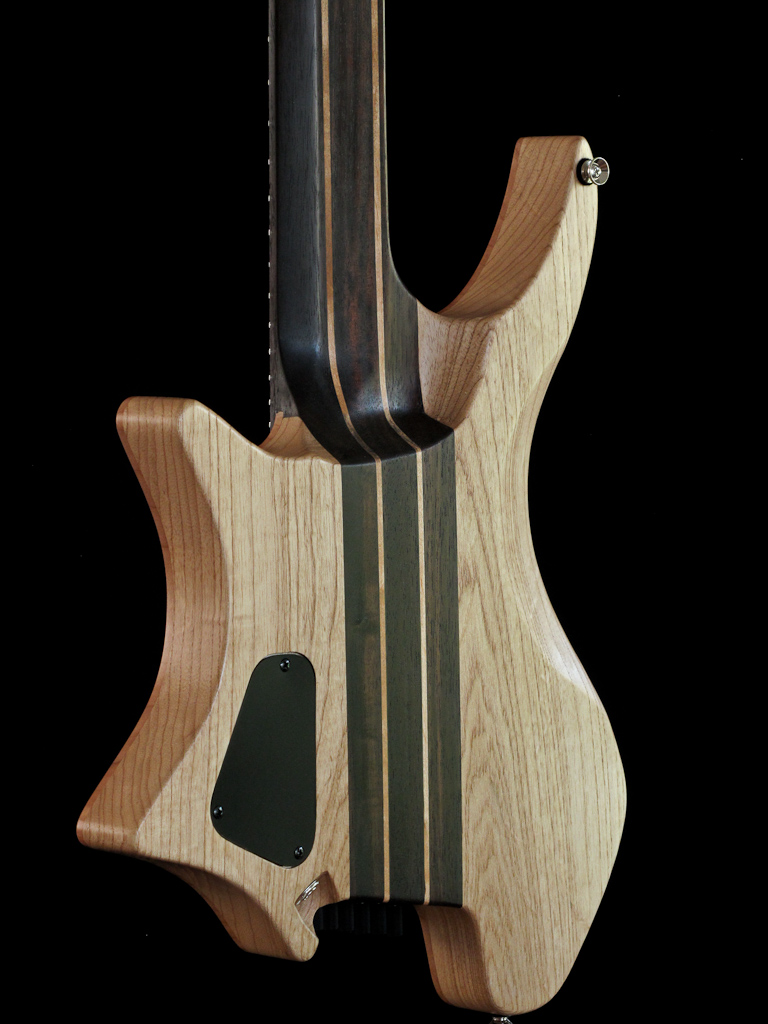
This crazy looking guitar is ergonomically designed to be comfortable sitting in all of the various permutations of posture most of us would play in, it's also got a forearm carve and a belly carve like most modern guitars. Then things start getting weird, it is a neck through and the neck is constructed of rosewood with maple and carbon fiber reinforcement. The neck itself is profiled to something called and intersecting planes profile, which is a Rick Toone idea, it involves having the neck shaped in a more angular way to facilitate better playing posture and comfort.

The point where the neck and the body meet bassically doesn't exist, the carbon fiber reinforcement allows for liberties to be taken with regards to shaping as it greatly improves structural integrity. The intersecting planes neck also aids in this as it actually ends up being thicker and more rigid than a standard neck, just in a way that wouldn't be uncomfortable.
Then there's the scale, as you can see it's a fanned fret design however in order to aleviate the issue of the fan being too great and becoming uncomfortable it has a fan within a fan - FANCEPTION! the 6 string section is on a normal 25,5" fanned scale and the 7th and 8th strings are on a 28,75" fan which adds two frets behind where the traditional nut would be and also keeps all of the frets angled in the same direction as opposed to a normal fan design where there's a center/straight fret and they fan out from there. The 8th string is tuned to a C# and the 7th is tuned to an A, so when he wants to return to his regular tuning of E-B-E-A-D-G-B-E he can just attach a capo on the second fret but this also opens up possibilities of having it tuned C#-A-E-A-D-G-B-E which is just cool.
Essentially this baritone hybrid scale is cool because it allows the extra strings to be on longer scales and retain more clarity and tension on the notes while your normal 6 strings are on a standard scale and therefore don't feel uncomfortable to navigate or have that over articulate extended scale snap which can get a bit overbearing on higher notes.
The pickups are custom made Lace Alumitones, these are essentially P-90s on an 8 string. The frets are stainless steel.
=
=
This track is played on that guitar using the C#-A-E-A-D-G-B-E tuning, it's a nice example as the first half has distorted tones and the end is clean.
tl;dr
There are some crazy ideas floating around and they're awesome, you just gotta look for them, also go here:
http://strandbergguitars.com/ and here for his blog where he details all of his various steps in creating this brand and how he overcame the various obstacles these designs posed
http://guitarworks.thestrandbergs.com/
Also these things are nowhere near as expensive as you'd expect, I priced an 8 string custom Strandberg at being R25k - Custom shop Fenders/ESP/Gibsons are normally way more than that, which is basically based off of brand name, heritage and resale value - I'd rather have a Strandberg.