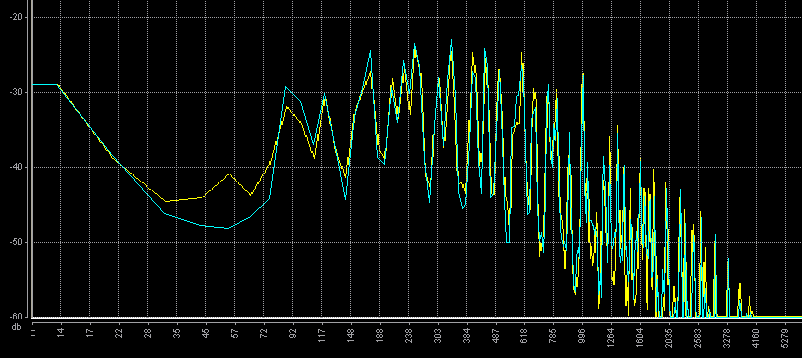
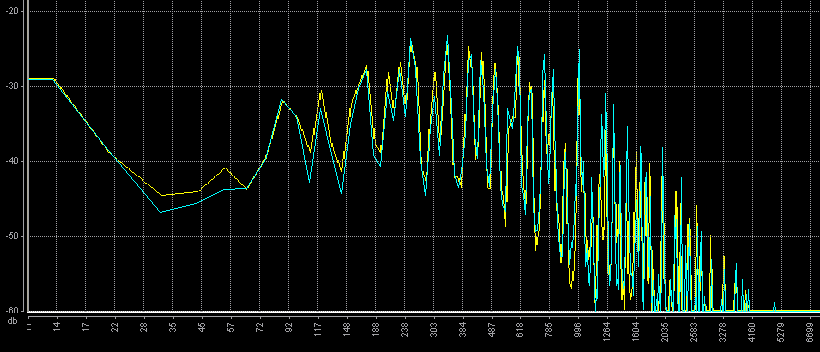
Skylark wrote
ezietsman wrote
Skylark wrote
There is more to a capacitor than its apparent value on the scope.
And even more so a capacitor interacting within a reactive musical circuit.
Prove it.
I'm not a scientist so I can't scientifically prove it but I do use common sense.
Ask Matta why he uses really expensive and particular Caps in his pedals and studio equipment?
Ask every single manufacturer that makes high end audio gear that same question.
Maybe you should enlighten them with your pearls of wisdom :
"all the caps, regardless of their Voltage Rating, material or any other factor, behaves the same in a tone circuit, as we should expect good working caps to do"
Applying your theory they could hugely cut costs and just buy whatever caps were cheap and at the correct spec , everytime basing their decision soley on your idea "all the caps, regardless of their Voltage Rating, material or any other factor, behaves the same in a ton circuit"
Of course there are reasons we even get different types capacitors. The examples you use of Matta and manufacturers of 'high-end' audio equipment maybe well be valid, but they use the capacitors in a different application. We're talking about the capacitor in your guitar's tone circuit here.
I don't have to ask them why they use expensive components. I know the reason(s). Mainly its because the more expensive components have tighter tolerances, so you know that when you buy for instance 0.022uF capacitors they'l be withing x% where the smaller x is the more expensive they become. Simple.
I understand you are not a scientist, most people are not, but it will be most enlightening to them (you) to learn how that method works. A scientist doesn't go around saying, "Look, so and so, does that, and so and so, says this, hence we reach a conclusion about the way something works" THAT is NOT common sense. If all your friends come to your place and claim to see a fairy in the back garden but you don't see it, is it OK to presume that there IS one? of course not. There is one if there really IS one.
Science. It works as follows: (and it works real good)
You have a theory about something. Can be anything. You note what it is. Then you use it to make a prediction, and that prediction should then be verified in such a way that other people who are not you can redo your measurements or experiment and obtain the same result. If the measurements do not agree with your theory, your theory is lacking somehow and needs adjustment. If the measurements DO agree, it means your theory applies at least in the domain the measurements where made in. It does not PROVE it but provides evidence that the theory may be sound. Most theories only apply in limited domains i.e. Newton's Laws only apply when speeds are much lower than that of light and when gravity is not very very strong.
Now, you made a claim about tone capacitors in guitar tone circuits, as have others and its widespread over the internet. I call BS and most engineers will agree. The onus is on you the believers to give evidence as to why you think your claims are correct. Thus far all I read everywhere is something along the lines of :
"Through my ears"
"In my opinion"
"your mileage may vary"
This is highly unconvincing. There is an industry around people who will do anything to get 'The Tone', even if that means installing R1000 worth of old capacitors in their guitars. Just because there is an industry around something, doesn't mean it really that something is based upon truth.