FG, there are so many new things you are going to learn and all of them important...... and one of those very important components is the II/V/I progression. ( IImin7/V7/Imaj7) It is the most important sequence in jazz.
You will find a II/V in almost every jazz song and in many cases there will be a few of them in each song. They are a very smooth way to transition into different keys. An example of a couple of II/V7's ......
||: E-7 / / / | A7 / / / | Dmaj7 / / / | / / / / | D-7 / / / | G7 / / / | Cmaj7 / / / | / / / / ?|
....or more jazzy even.......
||: E-7 / / /| A13 / A7#5 / | Dmaj7 / / / | / / / / | D-7 / / / | G7 / G7#5 / | Cmaj7 / / / | / / / /?|
Emin7th to ADom7th to D major 7th is the first II/V/I and Dmin7th to G7th to Cmaj7Th the second.
A good book is the Jamey Aebersold play along ...it comes with a CD that has lot's of II/V's progressions to improvise over. Learning how to approach improvising over a II/V is crucial.
http://www.amazon.com/Vol-II-V7-Progression-Improvisation/dp/B000001O58
Another trick I wanted to suggest is to initially
write yourself some solo's to several of the songs that the big band does. By write I mean work out a solo containing some licks, embellishment on the melody, some scales that work etc etc and "learn" that, so it is like you are playing a new melody over the changes, in the form of a worked out solo. Then when time comes that you are expected to blow a chorus, you are asked to take a solo, you can ask the
leader if you can try one of the songs you have been learning the solo's for...... rather than tackle improvising over the changes of a song you don't know. He should know that you are a beginner and likely your determination to do well and him seeing you have spent time working things out, will get his respect, and hopefully also a willingness to "take you under his wing" and help you.......I'll bet more than one older player will as well.
This is where having a good attitude comes in. It is key. Often bands prefer to have a great personality with less ability, than the super big time player who has a big head and is difficult to work with. Players who have come up themselves know what you are going through and a unit that has spent time weeding out the loose cannon's and jackasses is looking for someone who is keen to learn, has a good sense of humor, is always on time, who does what he is asked and who puts what is best for the band the band, before his own ego etc etc..........usually much more than someone who is a super hot player but is just awful to work with and be around etc.
As far as improvising, here is a little "trick" to try to help you get started: Get the Real Book for starters....the real Real Book, and pick some songs you want to learn. You realize fast, in looking at a complex set of jazz changes with multiple key changes, tonal gravities etc..... that one scale is not going to cut it
Firstly, learn the melody until you can play it in your sleep. Try to make a connection to what the writer has done as far as melody and the changes. If you can see it great, if not don't sweat it, but take sections of the melody and try expand on it to see where you could go if you were to embellish on it....maybe record yourself playing a loop of the changes and try different things out.....
around what the melody is doing.......use your ear big time.
But back to what I wanted to try illustrate.
Disclaimer: Simply trying to learn how to improvise using scales alone is limiting. This is just to get you headed in the right direction.
So, write out the chord sequence for the entire section of the progression in a particular song, that you want to learn to improvise over. Suss out what scales work for what sections of the changes. On top of the bars, bracket out in pencil each section that you have worked out what scale fits and write the name and key of the scale above that. For example, here is a very short section.......
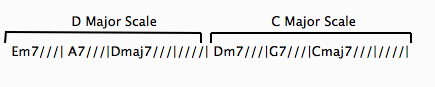
LOL....just a very fast idea but you get the picture.
Try and suss out different scales, not just the major scale.....see if there is a mode that is closely related, see if a certain scale might overlap into a bar and only make you change within the bar or phrase rather than at the beginning. Look for hip scales...can the Whole tone scale be used over a 7#5 chord, where is the Melodic Minor a good bet, if there is a diminished chord, can you integrate the Half Whole scale.....with a Dom 7th chord, can you look at what a substituted chord would be and use the derived scale or arpeggio for that instead? For example.... in the case of a 7th chord.....would a minor7b5 run a major 3rd above that sound cool? eg. G7 chord, play a B-7b5 run perhaps, maybe even try a Dm7b5?
Listen for which notes are strong and weak. Can you "add" the 9th and 13th intervals to a basic 7th chord or Maj 7th in your note choice and do those upper extensions of the chords sound hipper?
Do this for the entire section. Then record yourself playing the changes, either for a whole bunch of repetitions or just loop a single sequence. Now refer to your bracketed scales and try play a solo...... changing to each scale as it comes up. At first, try and stay in the same position for each scale so that the note changes are easily heard ....eg a minor 3rd that switches to a major 3rd etc or a perfect 5th to a flat 5th.
Later, as you get more familiar with what you are doing and with more scales, you can add more exotic scales and take things outside a bit etc etc and incorporate a new arpeggio you learned or a hip II/V7 run you figured out. Slowly you introduce hipper aspects to eventually get away from a dependence on scales alone-which are not going to give you the hippest sound anyway.
Once you have a few songs dialed that you can fake your way through using this method you can turn your attention to serious improvisational study..... the right way.....arpeggios, chord melodies etc etc etc and learn how to play really melodic.
I hope that was understandable somewhat?
I must stress again, that relying on scales can be restrictive. This suggestion of using them is just a starting point...it allows you to jump start yourself into improvising in jazz. As soon as you can you must engage in traditional study and also work on your ear. Try to think melody rather than just lick's. Anyone can learn to string a bunch of licks together. Licks and riffs are extremely important in the guitarists toolbox but are kinda lame if there is no overall sense of melody....they end up sounding like finger exercises.
If you do not know certain scales like the Harmonic Minor, Whole Tone, Half/Whole, Melodic Minor (jazz version) etc....plot them out on a neck diagram. Draw these up youself and make lot's of copies. Then write down dots on the "frets" for the notes of the various scales you want to learn. Try always say the note to yourself as you plot it, to learn the neck inside and out. Do this rather than download diagrams off the web......like I did below, for ease and speed.
Plotting the scale out yourself helps improve familiarity.
Your scale diagrams will look like this...... except you will write and underline the scale name with key, above it.
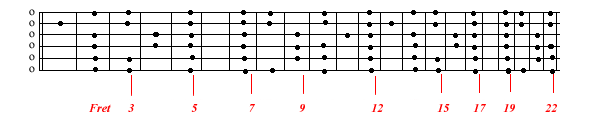
(to save me time.....this is courtesy-Chris Standring PWYH)
Below the diagram, write and underline
CHORD'S ON IT'S DEGREE'S and below that, create a box diagram, one vertical column for each degree of the scale written...I II II IV V VI VII and one horizontal column for each extension to the basic triad. The top horizontal row across will contain the basic triads found on each degree of the scale...eg for the Major scale.....
CHORD'S ON IT'S DEGREE'S
I II III IV V VI VII
Maj, Min, Min, Maj, Maj, Min, Dim.
The next will contain what kind of 7th chord....
CHORD'S ON IT'S DEGREE'S
I II III IV V VI VII
Maj, Min, Min, Maj, Maj, Min, Dim.
Maj7, Min7, Min7, Maj7, 7th, Min7, Min7b5
The next, what kind of 9th, then 11th, 13th.....do this for every scale you plot out.
For example, you can use neck diagrams to work out arp's or cool runs etc. Just looking at the example above I immediately "saw" a major 7th chord at the 3rd fret and 5th fret, in this case both are Gmaj7.
Here are some idea's I picked off. You can do these all day long and come up with cool stuff. Try it with different scales also to create different flavors, get creative with it.

So in looking at the diagram, one can see certain patterns that contain those notes as well as the 9th which is great to throw in.....the first is an arpeggio that also contains a passing note on the 1st string 4th fret thrown in for spice. The first two are examples of staying in the same position mostly.


This one shows how you can also use more of the fretboard, a diagonal approach ........ make up your own.

Another very good exercise is to learn to play over changes using a single string.......which in some ways is like a piano because the intervals are closer....when you sweep or jump from a low to high string on a guitar, these are big intervals for a piano ( not being a piano player ?) but often when you watch a pianist improvise in jazz....his right hand is doing most of the single line stuff and is usually within a certain range....sorta kinda....I mean they fly around but you get what I am saying right? Try one string at first, the high E...then include the B string and try find lines that flow nicely and so on. Just an idea. Pat Metheny learned like this when he took guitar improvising lessons from a famous pianist, early in his career.
Good luck with it.
Oh, I have not even touched on finger exercises to get your fretting hand disciplined as well as the picking hand, going for alternating up and down strokes...developing a high level of independence, speed, accuracy and also dynamics. I can post some if you need help with that.
I recommend you take a look at Chris Standring's awesome online course Play What You Hear.
http://www.playjazzguitar.com/index.html
I hope this has been helpful.